Hannah’s withholding of Mary’s suicide note
Here There Is No WhyHannah’s withholding of Mary’s suicide note is both a childhood act of possession and a delayed disclosure that reshapes the meaning of Mary’s death. Hannah found the note beside Mary’s body when she was five, recognized her own name, and kept the letter hidden from Judah for roughly twenty years. The concealment does not erase the message; it suspends it, leaving Judah and Hannah to live with an absence that the note was written to address. Its eventual appearance on an airplane turns private guilt into a carefully staged act of truth-telling and gives the family, at last, a written message from Mary rather than only the fact of her suicide.
Discovery and Immediate Concealment
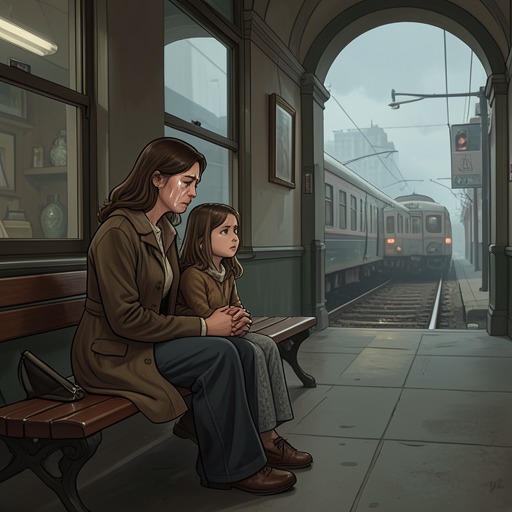
Hannah found the envelope on the steps when she found Mary’s body. The envelope was addressed to “Judah and Hannah” in Mary’s handwriting, but Hannah was too young to understand the full significance of either the note or the names. She could barely read, yet she recognized her own name and told herself that the letter was meant for her. She was not even sure whether she knew Judah’s first name. The uncertainty matters because the note’s dual address was present from the beginning, while Hannah’s childhood perception narrowed it into a possession that belonged to her alone.
The physical document remains remarkably intact when Hannah finally produces it. At thirty-two, she carries a white, letter-sized envelope in her backpack, unwrinkled and apparently preserved with extraordinary care. She has been intending to show it to Judah for about twenty years, perhaps longer. The note is therefore not merely forgotten evidence. Its continued presence, carried across childhood and adulthood, makes concealment a repeated choice even when Hannah’s understanding of that choice changes.
The Years of Withholding
Hannah later explains that she did not fully realize the letter was also for Judah until she was twelve. By then, the delay itself had become an obstacle. She feared that Judah would be angry because she had hidden the note for so long. When she was fifteen, during the trip on which she wrote a report about suicide bombers, she nearly told him, but sadness stopped her again. Each additional day made the secret feel worse, and the accumulated guilt made disclosure more difficult.
Her account refuses a single explanation. Hannah says that perhaps she forgot about the note, but she also admits that perhaps she always wanted to keep it from Judah because she wanted it to be hers, and hers alone. That uncertainty gives the action its emotional precision. The withholding is not presented as a calculated attempt to injure Judah. It is an impulsive response by a five-year-old to the sudden loss of her mother, later maintained by shame, fear, attachment, and the wish to possess one final private connection with Mary.
The hidden note also helps explain why Hannah reacts strongly when Judah tells her that Mary could not have left much for her to understand because she was five and unable to read. During the flight, Judah tries to comfort her by minimizing what a letter could have communicated to a child of that age. Hannah nods quickly, closes her eyes, and sheds a single tear. Her response shows that the missing note has remained emotionally active even before she reveals it: the document is absent from the shared story but present in her body and memory.
Confession in Flight
Hannah reveals the secret while traveling with Judah. She says she is afraid he will be angry and reaches into her backpack for the envelope. Her voice is diminished beneath the aircraft’s engine noise, and her rapid breathing conveys a pressure that she cannot yet organize into a simple explanation. Once she has admitted that the note exists, she tells Judah that she found it on the day of Mary’s death, recognized her own name, and gradually understood that it was addressed to both of them.
The confession becomes an account of delayed maturation. Hannah describes herself at five, twelve, fifteen, and then across the years in which the secret grew heavier. She says she held the note because she wanted it to belong to her, but she cannot fully explain why. Her uncertainty is not a gap the narrative needs to repair. It is the form taken by grief when an early act of self-protection survives long after the emergency that produced it. The adult Hannah can name the concealment as a sin, yet she cannot reduce the child who began it to a villain.
Judah responds by using the calming breathing technique Mary taught him. He tells Hannah that he is not angry and asks whether he should read the letter. Hannah insists that he should. The exchange reverses the earlier structure of the family secret: Hannah, who once controlled access to Mary’s final words, now authorizes Judah to receive them. Her disclosure is therefore not only an admission of wrongdoing but also a relinquishing of exclusive possession.
The Note and Its Return
The page is dated May 11, 1995, the day Hannah found Mary’s body. Mary wrote in a clear, careful hand with black pen. Her message says that she has to do this, apologizes for the hurt it causes, and explains that pain and tragedy had entered their lives months earlier and that her action would make things easier for everyone. She tells Judah and Hannah to be strong for each other, help each other, and love each other as she loves them.
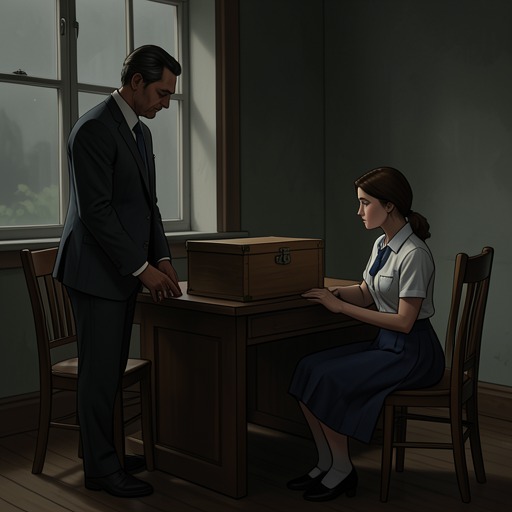
Judah handles the paper as though it were an ancient sacred text. The gesture gives the ordinary material of a suicide note the weight of an artifact preserved across a family’s silence. Yet the note does not solve the mystery of Mary’s suffering or undo her death. It offers an instruction for survival rather than a complete explanation: the survivors are to become responsible for one another. Its most consequential information is relational, because Mary addresses Judah and Hannah together and imagines their future as a shared obligation.
After reading, Judah folds the page and returns it to Hannah. For a moment he considers keeping it, but he does not repeat the possession that shaped Hannah’s secrecy. Instead, he says that Mary did not intend for Hannah to find it. Hannah closes her eyes, and the note passes back into her hands with its status changed. It is no longer a child’s private relic or an undisclosed piece of evidence; it is a message that has been read by both intended recipients.
Narrative and Thematic Significance
The withholding delays the book’s movement from unexplained death toward mournable loss. Judah has built a life around unanswered questions, including professional efforts to reconstruct other deaths and concealed truths. The missing note makes Mary’s suicide another unresolved absence. When Hannah produces it, the revelation does not restore the dead; it changes the ethical relationship between the living by exposing what one survivor knew and what the other was denied.
The action also echoes the book’s larger conflicts over secrecy, truth, and political convenience. Zehava and Charlie defend the concealment of Chaim Lerner’s death by invoking reputation, national interest, and the possibility of peace. Hannah’s concealment is intimate rather than political, but it likewise shows how a truth can be withheld because disclosure appears unbearable. The difference is that Hannah eventually confesses without bargaining for public advantage. Her return of Mary’s note contrasts with the broader systems that convert hidden violence into a usable story.
At the same time, Hannah’s act complicates any simple opposition between truth and concealment. She was five when she found the note, and her first impulse was to claim the only surviving object that seemed to belong directly to her relationship with Mary. The adult confession recognizes the harm in that choice while preserving the child’s vulnerability. The note’s delayed reading thus becomes a small family version of the book’s central question: whether truth can arrive late and still perform a form of repair. It cannot change what happened on May 11, 1995, but it allows Judah and Hannah to receive Mary’s final appeal together and to begin, however imperfectly, the mutual care she asked of them.